
Bookkeeping
Comparison
Financials
restaurant P&L too late
monthly P&L timing restaurant
late restaurant financials
Why Your P&L Arrives Too Late to Matter

Ryan
Why Your P&L Arrives Too Late to Matter
5:43
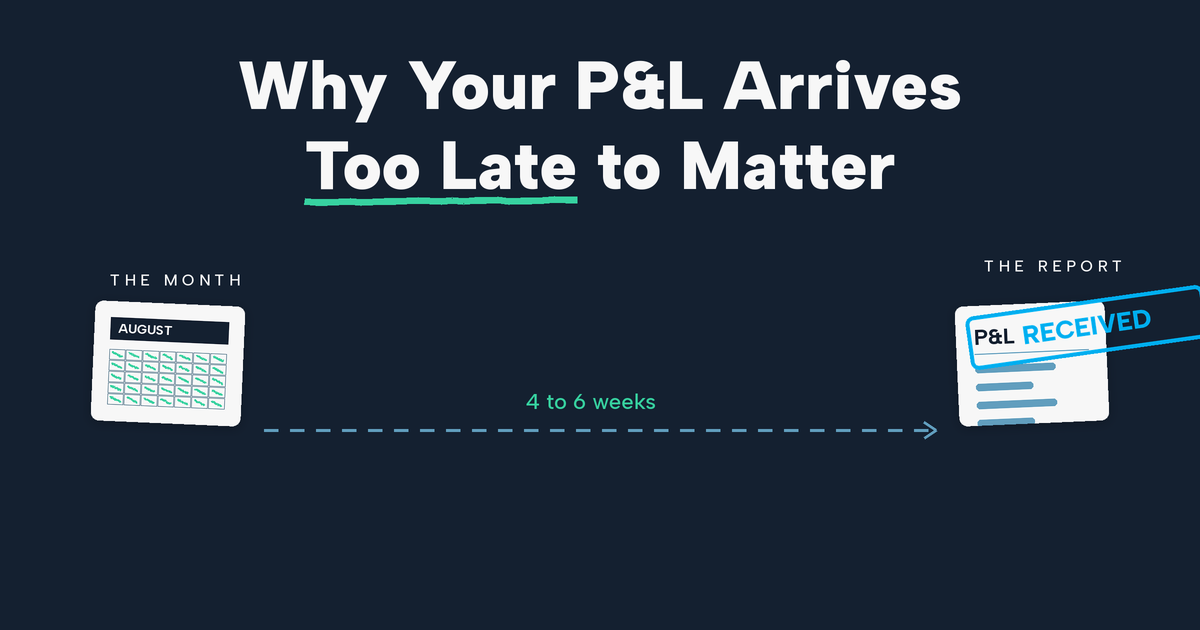
A restaurant P&L that arrives 4 to 6 weeks after the month ends can't change anything, no matter how accurate it is. By the time it lands, next month's schedule is written, the food is ordered, and the prices are set, so the report describes a month you can no longer touch. For a P&L to actually matter, it has to arrive within days of month close, while those decisions are still open. FIXE's standard is a monthly P&L within 5 business days.
I want to talk about the version of this I see all the time. Not messy books. Not wrong books. Good books that show up too late to do their job.
How late is a normal restaurant P&L?
Here's the pattern I see over and over with operators. The month ends. You send everything off, or your bookkeeper starts chasing what's missing. Invoices trickle in. Questions go back and forth. And somewhere around 4 to 6 weeks later, the P&L for that month finally shows up in your inbox.
Nobody's lying to you. Nobody's lazy. That's just what the process produces when the books are treated like a filing task instead of a management tool. Most operators I talk to assume that lag is normal, the way weather is normal. It's so common that when I ask an owner how last month went, the honest answer is usually "I'll know in a few weeks."
Read that back. You're running the business now. You'll know how it went in a few weeks.
Why doesn't accuracy save a late P&L?
Everybody who sells bookkeeping sells accuracy. And accuracy matters. I'm the guy who'll tell you that you can't compare a 28-day February straight across to a 31-day month, so believe me, I care about the books being right.
But nobody tells you that accuracy has a shelf life.
A P&L is a decision-making tool. It exists to answer questions like: is food cost creeping? Did labor get away from us? Can we afford that repair? Those questions have deadlines, because the decisions behind them have deadlines. A perfectly accurate answer that arrives after the deadline isn't an answer anymore. It's trivia.
The report didn't fail an audit. It failed a deadline.
That's the paradox. Your bookkeeper can do everything right, tie out every account, and still hand you something useless, because useful was never only about correct. Useful is correct plus on time. One quick aside: if your P&L looks profitable but your bank account is empty, that's a different disease entirely, and I covered it in Why Your P&L Says Profit but Your Bank Account Is Empty. Today is about the report that's right and late.
What decisions does a late P&L miss?
Walk the timeline with me. Say January ends and the January P&L arrives in mid or late February, 4 to 6 weeks out. What already happened while you were waiting?
- The schedule got written. February's labor was committed before you ever saw January's labor number. If January's labor ran hot, February inherited the problem.
- The food got ordered. Your ordering pars, your vendors, your prep counts all rolled forward on habit, not on data.
- The prices stayed put. If a category quietly lost margin in January, it kept losing margin every day you didn't know.
Every one of those decisions is exactly what the P&L was supposed to inform. And every one of them was already made by the time it showed up. That's why I say a late P&L isn't a management tool, it's a history lesson. You can't run a restaurant looking in the rearview mirror.
There's a people cost too, and it's the one I think gets missed most. If you run managers, you can't hold anyone to a number from six weeks ago. The month is too far gone, the details are foggy, and everybody knows it. A stale number isn't enforceable. So the report that was supposed to create accountability quietly creates none.
How fast does a P&L need to be to matter?
Fast enough that the decisions it should inform are still open. In practice, that means days after month close, not weeks.
Our standard at FIXE is a monthly P&L within 5 business days of month close. That's the public bar we hold ourselves to, and we hold it across 600+ restaurant locations, so I can tell you it's not a fantasy number. It's what the process produces when the books are built for speed on purpose: clean daily habits, invoices in on a rhythm, no month-end scramble.
Five business days changes what the document is. You're reading January in the first week of February, while February is still wet cement. Labor ran hot? You adjust this week's schedule. A category lost margin? You're on the phone with the vendor today. The same report, moved up the calendar, goes from trivia back to being a tool.
So here's the reframe I want you to leave with. Stop grading your books only on whether they're right. Start grading them on when they arrive. Ask your bookkeeper one question: how many days after month close do I get my P&L? If the answer is measured in weeks, your books aren't bad. They're late. And late is fixable.
What do you do between monthly P&Ls?
One more thing, because the sharpest operators I work with ask it immediately: even a fast monthly P&L only shows up once a month. What do you watch in between?
There's a good answer, and it doesn't involve pretending to close your books every week. It's a weekly number that's close enough to act on while the week is still happening. I wrote up exactly how it works in The Restaurant Weekly Flash Report: How to Watch Your Week Without Closing the Books.
And if you're wondering where your books actually stand today, speed included, take the FIXE Health Score quiz. It's quick, there's no sales pitch, and you'll know which part of your back office to fix first.