

Tipping
Bookkeeping
FIXE
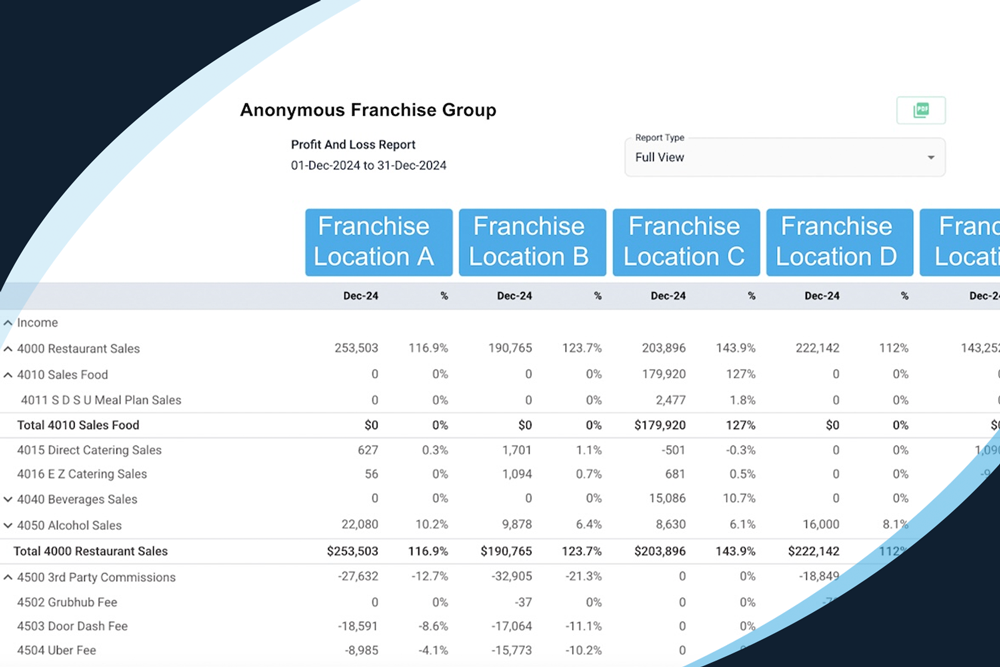

Short answer: The financial reporting problems that show up when a restaurant group grows past two or three locations are almost never about the software. They're about inconsistency: a different chart of accounts at each store, sales recorded differently by each POS, payroll split across entities, vendors invoicing whichever location is convenient, and intercompany transfers nobody reconciles. Fix the structure first (one chart of accounts, one sales journal format, one close calendar, one vendor process, entity-level books that consolidate cleanly) and the reporting problems mostly disappear. Then the software choice is easy.
I've watched a lot of two-location operators become six-location operators, and the finance conversation changes in a predictable way. At one location you want to know if you made money. At three you want to know which store is winning and why. At six you want a package you can hand to a lender, a partner or a new director of operations without a twenty-minute explanation. This guide is the structure that gets you there, in the order I'd build it.
When I ask growing groups what's wrong with their reporting, the answers cluster into six problems. Notice that none of them are "we need a better dashboard."
Here's the order of operations. Do these in sequence, because each one depends on the one before it.
Build one restaurant-specific chart of accounts and make it non-negotiable at every location. Sales broken into food, beverage (with alcohol separate if you serve it), delivery, catering and other. COGS matched to those sales categories. Labor split into front of house, back of house, management, payroll taxes and benefits. Occupancy, operating expenses and delivery platform fees on their own lines. If a new location wants a special account, the answer is usually no. Comparability is worth more than precision on a small line.
Every store should produce a daily or weekly sales journal in the same layout: gross sales by category, discounts and comps, sales tax collected, tips collected, and tenders (cash, card, delivery platforms, gift cards) so each tender reconciles to its own deposit. If your locations run different POS systems, the journal format is where you normalize them. We covered the mechanics in why your sales and bank deposits don't match and the delivery reconciliation guide.
Most groups end up with an LLC per location, sometimes a management company on top. Keep a full set of books for each entity, on the same chart of accounts, and consolidate at the reporting layer rather than merging the books. That keeps your tax filings clean, keeps partners with different ownership percentages happy, and still gives you one group P&L. Intercompany transactions get their own accounts and get cleared monthly, not annually.
Pick monthly or 13 four-week periods (we prefer periods for restaurants, and explain why in 13-period accounting for restaurants) and close every location on the same schedule with the same deadline. A group can't have a consolidated close that's faster than its slowest store, so the calendar is what forces discipline on invoice submission and inventory counts. Our standard is a finished P&L within five business days of period close, for every entity, so the consolidated package is ready the same week.
Route all invoices through one intake process, code them to the right location and account, approve them against a rule set, and pay on one weekly run. That gives you consolidated AP, per-location purchasing visibility, and the ability to negotiate on group volume. If you're still paying from each store's checkbook, read the complete guide to restaurant AP automation before you add another location.
Consolidated statements are the group's financials as if it were one business: every entity's P&L and balance sheet added together, with the money that only moved between your own companies taken out. They're how you see the whole group at once, and how a lender or partner will read it.
These are two different cuts of the same books, and a group needs both. The location view is operational: one column per store, so you can compare prime cost, labor and margin between restaurants. The entity view is legal and tax: one set of statements per LLC, which is what your CPA files from and what partners with different ownership stakes are paid from. Usually the two line up one to one, but not always. A management company, a central kitchen or a commissary is an entity with no dining room, and two concepts can share one LLC. Set up your chart of accounts and location tracking so the books can produce both views without a spreadsheet.
When one of your entities pays another, the group as a whole hasn't earned or spent anything. Consolidation removes those transactions so they don't inflate sales or expenses. The common ones in restaurant groups:
If the two sides of an intercompany balance don't match, something got booked on one side and not the other. Find it before you consolidate, not after.
Once the consolidated statements are ready, walk them in the same order every period:
Once the structure is right, the package is straightforward. This is what a six-location group should be able to open, in one place, within a week of period close.
| Report | Level | What it answers | Frequency |
|---|---|---|---|
| P&L by location, side by side, with percentages | Location and consolidated | Which stores are winning and where the margin gap is | Period |
| Prime cost trend | Location | Is COGS plus labor drifting, and at which store | Weekly and period |
| Balance sheet by entity, with intercompany schedule | Entity and consolidated | What each entity owns and owes, and who owes whom inside the group | Period |
| Cash position and 13-week cash view | Consolidated | Can the group cover payroll, rent and vendors through the quarter | Weekly |
| Delivery platform reconciliation summary | Location | Gross delivery sales, fees, refunds and chargebacks per platform | Period |
| AP aging and vendor spend by category | Consolidated with location detail | What's owed, what's overdue, what each store pays per unit | Weekly |
| Weekly KPI flash | Location | Sales, labor and purchases against last week and budget, before the period closes | Weekly |
If you only build two of these, build the side-by-side P&L and the weekly KPI flash. The first is how you manage the group; the second is how you catch problems before the period P&L makes them permanent. We wrote a template for the flash in the restaurant weekly flash report.
Allocate, don't guess. Shared labor (a regional manager, a catering team, a central kitchen) should be booked to a shared-services entity or cost center and allocated to locations on a stated basis: hours worked, sales, or a fixed percentage. Write the basis down and apply it the same way every period. The same rule applies to shared marketing, insurance and software. The goal is that each location's P&L reflects its real cost to operate, so a store that looks profitable is actually profitable after its share of the overhead.
Later than most people think. In my experience, QuickBooks Online with one file per entity, a consistent chart of accounts, and a reporting layer on top can carry a group a long way, often into the low double digits of locations, provided the bookkeeping is disciplined. Platforms like Restaurant365 or Sage Intacct earn their cost when you have in-house accounting staff to run them, need inventory and labor in the same system as the ledger, or are past that size. We compared the options in best Restaurant365 replacements for small groups. The short version: buy structure first, software second.
Is your group's reporting still living in a spreadsheet?
FIXE is restaurant bookkeeping software with the bookkeeper included, trusted by 600+ restaurant locations. Book a demo and we'll show you what a side-by-side package looks like for your group.
Book a demoTake the free Health ScoreInconsistent charts of accounts across stores, sales journals that differ by POS, payroll and shared costs that cross entities without allocation, fragmented vendor payments, uncleared intercompany balances, and consolidation done by hand in spreadsheets. Each one makes locations harder to compare and the group harder to finance.
Yes, if each location is its own legal entity, which is the common structure. Keep full entity-level books on a shared chart of accounts and consolidate at the reporting layer. That preserves clean tax filings and partner reporting while still producing one group P&L.
They're the group's P&L and balance sheet presented as if every location and entity were one business, with transactions between your own companies (management fees, shared purchasing, loans between entities) eliminated. They give you and your lender one view of what the group earns, owns and owes, with location columns that show which stores drive the result.
Standardize the chart of accounts and close calendar first, book intercompany transactions to dedicated accounts, then produce consolidated statements that sum the entities and eliminate intercompany balances. With consistent books this is a report, not a project. With inconsistent books it's a monthly spreadsheet exercise that's always slightly wrong.
Within five to ten business days of period close, with the location-level statements finished first. The consolidated view can't be faster than the slowest store, which is why a single close calendar with hard deadlines matters more than any software feature.
A restaurant-native one can, and for growing groups without in-house accounting staff it's often a better fit than hiring a controller and buying a platform. Look for entity-level books on a shared chart of accounts, a stated close timeline that applies to every entity, consolidated AP with location coding, and side-by-side reporting as standard output. That's how FIXE runs books for groups, and you can see plan pricing per location on the pricing page.