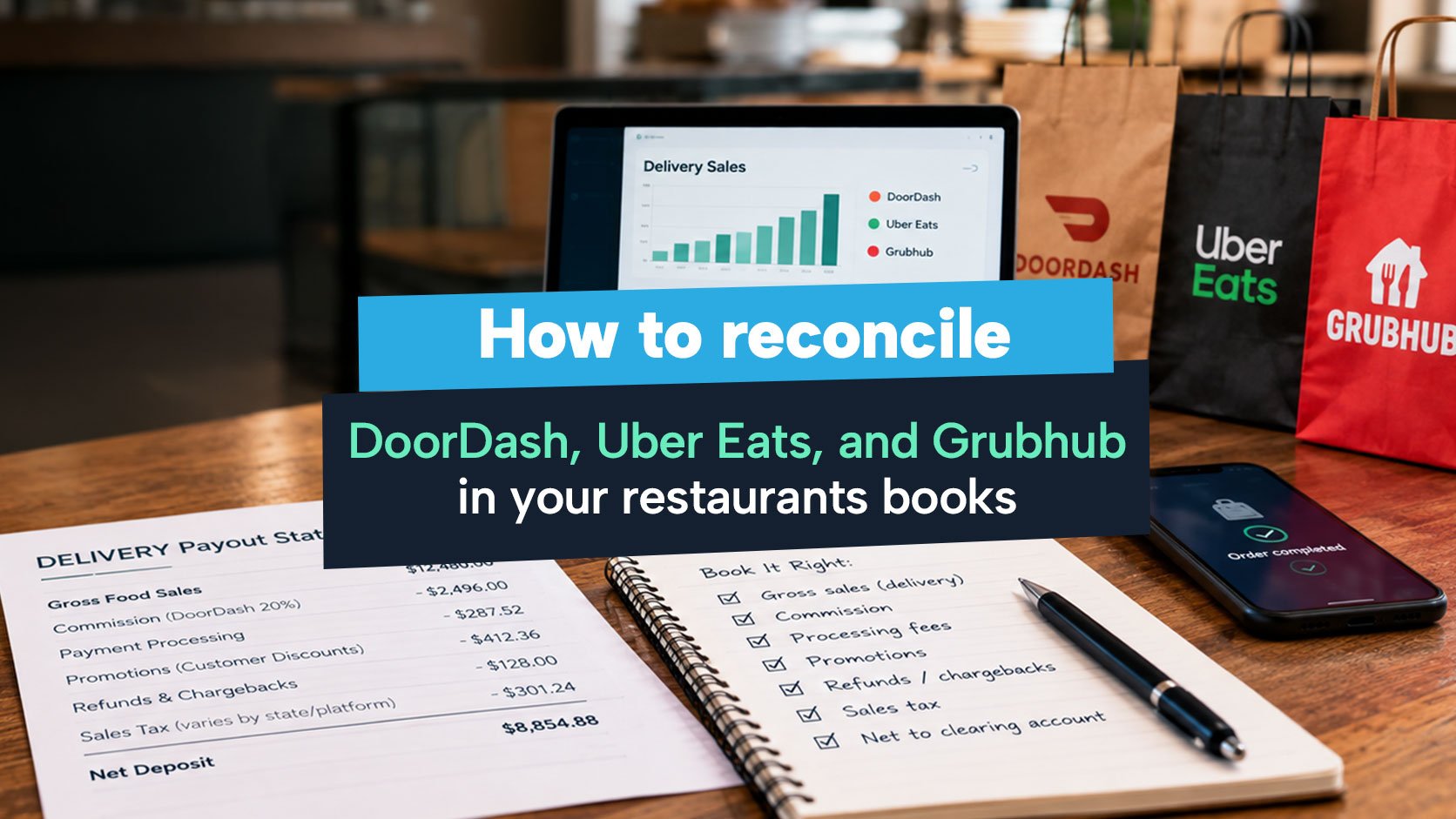
Short answer: The deposit that lands in your bank from DoorDash, Uber Eats or Grubhub is not your sale. It is the sale minus commission, minus processing, minus promotions you funded, minus any refunds and chargebacks, arriving several days later. Recording the deposit as revenue understates your sales, hides the entire cost of delivery, and makes your food cost percentage look wrong. The fix is to record gross sales from the platform statement, book each deduction to its own expense account, and reconcile the net figure against the bank.
This is the most common bookkeeping error I see in restaurants that do meaningful delivery volume, and it is also one of the most expensive, because it hides the number you most need: what delivery actually costs you.
If your books show delivery as a modest line and your gut says it feels more expensive than that, this is usually why.
Why is the deposit not the sale?
A single order goes through several deductions between the customer paying and money reaching you.
| Component |
What it is |
Where it belongs |
| Gross food sales |
The menu price of what the customer ordered |
Sales revenue, delivery category |
| Commission |
The platform's percentage, often the largest single deduction |
Its own expense account, not netted against sales |
| Payment processing |
Card processing charged on top of commission |
Merchant fees expense |
| Promotions you funded |
Discounts and free delivery offers where you carried the cost |
Marketing expense, so you can judge whether it worked |
| Refunds and chargebacks |
Orders refunded to the customer, sometimes at your expense |
Contra revenue, reducing sales |
| Sales tax |
Sometimes remitted by the platform as a marketplace facilitator, sometimes not |
Depends on state and platform, and it must be checked |
| Tips to drivers |
Passed through, never yours |
Not your revenue and not your liability |
Record only the net deposit and every one of those disappears into a single number. Your sales are understated, your marketing spend is invisible, and there is no line on your P&L that answers "what is delivery costing us."
How do I record third party delivery sales correctly?
The pattern is the same on every platform. Do it per platform, per period.
- Pull the platform payout statement for the period, not the bank deposit. Every platform provides one. It is the source document.
- Record gross sales to a delivery sales account, separate from dine-in and pickup, so you can compare channel margins later.
- Record each deduction to its own expense account: commission, processing, funded promotions.
- Record refunds and chargebacks as contra revenue rather than as an expense.
- Book the net to a clearing account, then match the bank deposits against that clearing account as they arrive.
- Confirm the sales tax treatment for each platform in each state you operate in, and document it.
The clearing account in step five is what makes this survive the timing gap. Sales happen in one period and cash arrives in the next, and a clearing account holds that difference visibly rather than making your reconciliation mysteriously fail.
What about the timing gap?
Platforms pay on their own schedule, usually weekly, and the payout period rarely lines up with your accounting period. An order on the last day of the period may not settle until the middle of the next one.
This is exactly what accrual accounting is for. Record the sale when it happens, hold the receivable in the clearing account, and clear it when the deposit lands. If instead you record sales when cash arrives, your period-end sales figure will always be wrong by roughly a week of delivery volume, and it will be wrong by a different amount every period, which makes period comparisons useless.
Does the POS integration handle this for me?
Partly, and the gap is where the errors live. Most POS integrations bring the order in as a sale, which is the easy half. What they usually do not do is book the commission, processing and funded promotions to separate expense accounts, or reconcile the eventual deposit.
So a POS integration typically gets you accurate gross sales and leaves the entire cost side unhandled. Check specifically whether yours writes the fee detail through to your accounting system. Most do not.
What should I actually do with the numbers once they are right?
This is the point of the whole exercise. Once delivery sales and delivery costs sit on separate lines, you can calculate the real contribution margin per channel and answer questions you currently cannot.
Is delivery profitable after commission at your current menu prices? Should delivery prices differ from dine-in prices? Is the promotion you funded last period actually driving repeat orders, or buying one-time discount seekers? Which platform is worth the counter space?
None of those are answerable while the whole thing is one net deposit line. All of them are straightforward once it is not.
At FIXE, restaurants are all we do, across 600+ restaurant locations, and delivery reconciliation is part of the standard monthly close rather than an add-on, because at this point almost every restaurant needs it.
Frequently asked questions
How do restaurants reconcile DoorDash fees in their books?
Pull the DoorDash payout statement rather than working from the bank deposit, record gross food sales to a delivery sales account, book commission and processing to separate expense accounts, record refunds as contra revenue, then post the net to a clearing account and match deposits against it as they arrive.
Should delivery sales be recorded gross or net?
Gross, with every deduction recorded separately. Recording net makes your revenue look smaller than it is and makes the cost of delivery invisible, which means you cannot tell whether the channel is profitable.
Who remits sales tax on third party delivery orders?
It depends on the state and the platform. Many states treat delivery platforms as marketplace facilitators required to collect and remit, but coverage is not universal and the treatment differs by platform. Confirm it per platform per state and keep the documentation, because assuming the platform handles it is a common and expensive mistake.
Are driver tips part of my restaurant revenue?
No. Tips paid to a platform's delivery driver pass through to that driver and are neither your revenue nor your liability. This is different from tips left for your own staff, which are a liability on your balance sheet until paid out.
How do I tell whether delivery is actually profitable?
Separate delivery sales from dine-in sales, subtract the food cost on those orders plus commission, processing and any promotions you funded, and compare the margin to your dine-in margin. You cannot do this at all until the fees are recorded separately, which is why the bookkeeping treatment matters beyond tidiness.
Want to know whether your delivery numbers are being recorded correctly right now? Take the FIXE Health Score quiz.