
Franchises
Bookkeeping
Comparison
3rd Party Apps
FIXE
DoorDash
Chargebacks and Receivables for Restaurant Groups

Ryan Handel
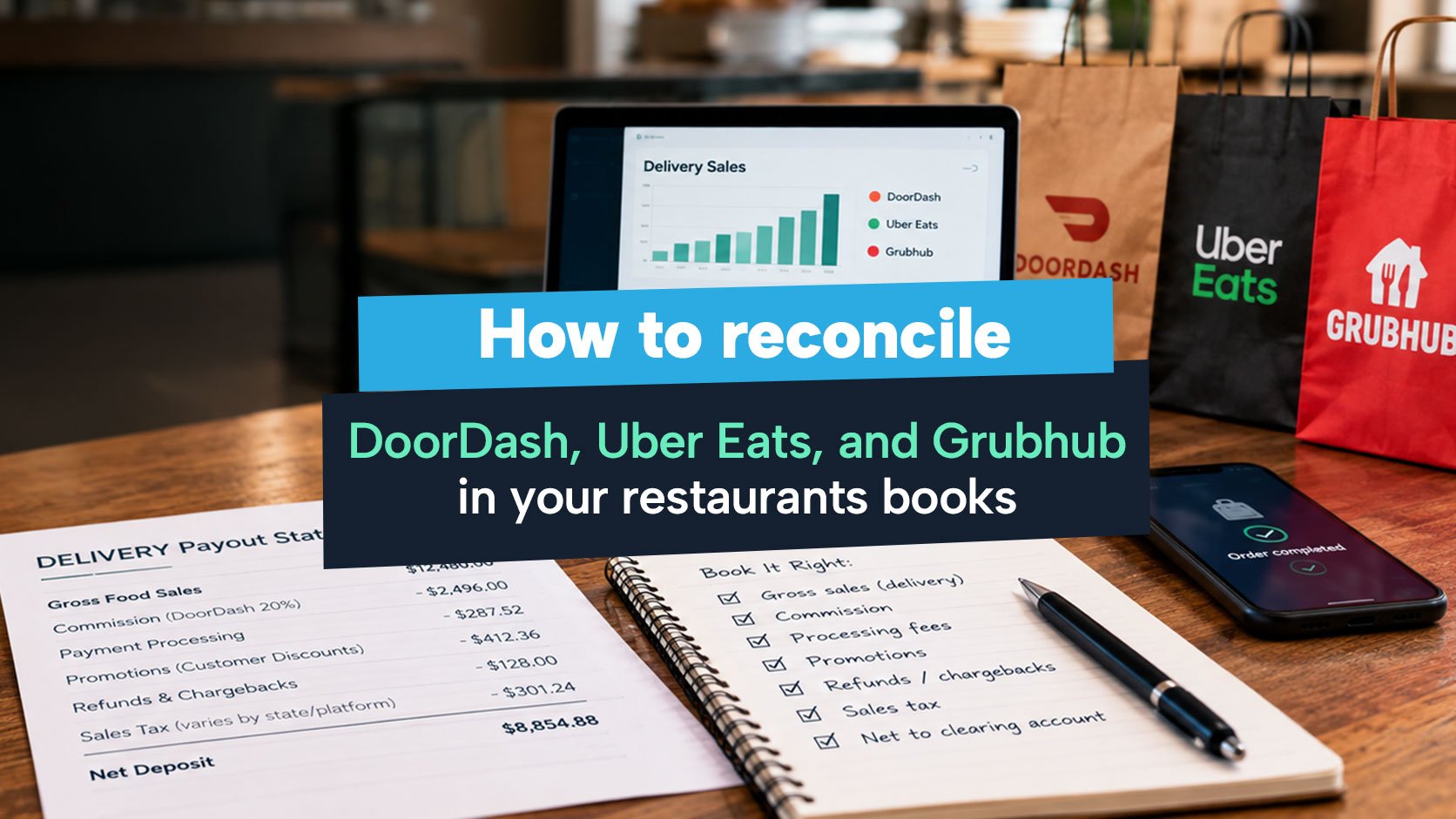
Short answer: Restaurants reconcile DoorDash, Uber Eats and Grubhub fees and chargebacks correctly by treating each platform as a customer that owes you money, not as a bank deposit. Book gross order value as sales when the order happens, book commissions and marketing fees as expenses, book refunds, error adjustments and chargebacks as reductions against a platform receivable, and clear that receivable when the payout lands. Do it per platform, per payout period, and dispute every chargeback you can document. For a group, do it the same way at every location so the numbers compare.
We have written about the mechanics of delivery reconciliation before, and I will link those guides below. This piece is about the part that trips up multi-location groups specifically: the receivables and the chargebacks. Those are where real money leaks, and where the books at most groups are quietly wrong.
What is restaurant chargeback reconciliation?
Restaurant chargeback reconciliation is the process of matching every refund, error adjustment and dispute that a delivery platform or card processor takes back from your sales to the order it came from, booking it to the right account, and confirming that the payout you received equals what the platform owed you after those deductions. In plain terms: you check that every dollar pulled back was tied to a real order problem, you dispute the ones you can document, and you make sure your P&L shows all of it, including what you win back.
It's one part of delivery reconciliation, and it's easy to confuse with the other parts. Here's how they differ.
| What you're reconciling | The question it answers | Where it lands in your books |
|---|---|---|
| Fees (commission, delivery, marketing) | What does this channel cost me? | Delivery fee expense and marketing expense, by platform |
| Chargebacks and error adjustments | What did I lose after the order left the kitchen, and how much did I get back? | Contra-sales (sales returns), by platform and reason code |
| Payouts | Did the cash I received match what the platform owed me? | Cash, clearing the platform receivable |
If you only reconcile payouts, fees and chargebacks blur together into one smaller deposit, and you can't tell a pricing problem from an operations problem.
Why should delivery platforms be treated as receivables?
Because that is what they are. When a guest orders through DoorDash, you delivered food and DoorDash owes you the money. It pays you later, net of whatever it decided to deduct. If your books only record the deposit, three things go wrong at once:
- Sales are understated by the fees, so food cost and labor percentages are overstated.
- Fees are invisible, so you cannot see what delivery actually costs you or negotiate it.
- Timing is wrong, because the deposit for the last few days of the period lands in the next period, and nobody accrues it.
Treating each platform as a receivable fixes all three. Sales are recorded when earned, fees are recorded as the expense they are, and the balance sheet shows what each platform owes you at period end. Across a group, that receivable by platform by location is also the fastest way to spot a store where something is off.
What is actually inside a delivery payout?
Every platform statement, however it is formatted, breaks down into the same components. This is the map we use for every reconciliation.
| Component | How to book it | Where it hurts if you get it wrong |
|---|---|---|
| Gross order subtotal | Sales, by category if the platform provides it | Understated revenue and overstated cost percentages |
| Sales tax collected | Sales tax liability if you remit; not revenue. Note that in marketplace facilitator states the platform remits it, so it should not appear in your liability at all | Double-paying or under-paying sales tax |
| Customer tips | Tips payable liability, cleared when paid to staff | Tips booked as revenue inflate sales and create a tax problem |
| Commission and delivery fees | Delivery platform fee expense | Hidden cost of delivery; no basis to negotiate |
| Marketing, promotions, sponsored listings | Marketing expense, separate line from commission | Promo spend disappears into "fees" |
| Platform-funded promotions | Not your expense; sales stay gross, the platform's contribution offsets against the receivable | Sales understated if you net it |
| Refunds and order error adjustments | Contra-sales (sales returns), tracked by reason code | These are your chargebacks; unmanaged, they compound |
| Chargeback reversals from won disputes | Reduce contra-sales in the period the reversal posts | Won disputes never get booked, so the P&L understates recovery |
| Net payout | Cash, clearing the platform receivable | If this is the only entry, everything above is missing |
How do chargebacks work on delivery platforms?
"Chargeback" on delivery platforms usually means an error adjustment: a guest reports a missing item, a wrong order, a cold delivery or a late order, and the platform refunds the guest and deducts some or all of it from your payout. Each platform has its own name and dispute window, but the workflow is the same:
- Capture every adjustment with its reason code from the platform statement, not just the total. Missing item, wrong item, order never arrived, quality complaint and cancellation are different problems with different owners.
- Dispute what you can document. Platforms allow disputes within a window (typically days, not weeks) and generally require evidence like a photo of the sealed bag, a POS timestamp, or a driver hand-off record. A meaningful share of adjustments get reversed when disputed with evidence, which is why the window matters.
- Book the adjustment as contra-sales in the period it hits, and book the reversal when the platform posts it. Do not net them against each other or wait for the dispute to resolve.
- Report the rate. Adjustments as a percentage of gross delivery sales, by platform, by location, every period. Anything above a couple of percent is an operations problem, not an accounting problem, and the reason codes tell you which kind.
At FIXE we track delivery fees and adjustments per platform as standard and handle the dispute filing for our customers, because the dispute window closes faster than a monthly close cycle. If you are doing this yourself, assign it to a person with a weekly deadline, not a month-end task.
How do you reconcile delivery app chargebacks step by step?
Here's the routine we'd hand a new bookkeeper. Run it for every payout, for every platform, at every location.
Step 1: Pull the payout report, not just the deposit
Download the payout or transaction report for the period from each platform's merchant portal, at the order level if you can. The bank deposit tells you how much arrived. Only the report tells you why it's that amount.
Step 2: Match the net payout to the bank deposit
Tie each payout on the report to a deposit in the bank feed. If a payout is missing, split, or combined with another store's, sort that out first, because nothing downstream will tie until it does.
Step 3: Break the payout into its components
Use the payout table above: gross sales, tax, tips, commission and delivery fees, marketing, platform-funded promotions, adjustments, reversals and net payout. Gross sales less every deduction should equal the net payout to the penny. If it doesn't, there's a line you haven't found yet.
Step 4: Tie every adjustment to an order and a reason code
For each refund or error adjustment, find the order in your POS or order tablet history. Note the reason code, the amount, and whether you have evidence: a timestamp, a photo, a hand-off record. This list is your dispute queue.
Step 5: Dispute what you can document, inside the window
File disputes through each platform's merchant portal before the window closes. Windows and evidence rules differ by platform and change over time, so check the current rules in each platform's merchant help center rather than relying on what was true last year. Log every dispute with its filing date so you can match the outcome when it posts.
Step 6: Book adjustments, reversals and the open receivable
Book adjustments to contra-sales by platform, book reversals when they post, and clear the platform receivable with the net payout. Whatever's still open at period end (unpaid days, pending disputes) stays on the receivable and gets accrued, which is covered below.
How do delivery disputes flow to the P&L?
A dispute touches your P&L twice, often in two different periods. That's the root of most delivery-related P&L mismatches. Here's the path one adjustment takes.
| Event | What happens to cash | What hits the P&L | Which period |
|---|---|---|---|
| Guest orders through the platform | Nothing yet; the platform owes you | Gross sales, plus fee and marketing expense | The period the order happened |
| Guest complains and the platform refunds them | Deducted from your next payout | Contra-sales, which lowers net sales | The period the adjustment posts |
| You file a dispute | Nothing yet | Nothing yet; it's a pending item on your dispute log | None |
| You win the dispute | Added back to a later payout | Reversal, which reduces contra-sales | The period the reversal posts, often the next one |
| You lose the dispute | No change | The adjustment stays as lost sales | Already booked |
So where do the mismatches come from? Usually one of these:
- Deposit-only booking. Adjustments never show up as their own line, so net sales look fine while real sales and real losses are both hidden.
- Netting. Adjustments and reversals get netted against fees or against each other, so the adjustment rate you report is wrong.
- Timing. A big adjustment lands in one month and its reversal in the next, so one month looks worse and the next looks better than either really was. Booking both when they post, and noting open disputes, keeps that visible instead of confusing.
- No reason codes. Without them you can't tell a packing problem at one store from a driver problem on one platform, and you can't fix either.
When adjustments run through contra-sales with reason codes, net sales are honest, food cost and labor percentages are calculated on the right base, and the adjustment rate becomes a number your operators can actually manage.
How should a restaurant group standardize this across locations?
The single-location process is manageable by hand. At five locations across three platforms it is fifteen reconciliations a period, and it only works if every store does it identically.
- Same GL accounts everywhere: a receivable per platform, a fee expense per platform, a marketing expense per platform, a contra-sales account for adjustments. No store gets its own version.
- Same cadence: reconcile every payout, not every month. Weekly payouts mean weekly reconciliations.
- Same reporting: one table per period, locations as rows, platforms as columns, showing gross sales, effective fee rate and adjustment rate. That table is where you find the store paying 4 percent more in promotions or losing 3 percent to missing-item claims.
- Same dispute owner: centralize it if you can. One person filing disputes across all stores gets better at it than five managers doing it occasionally.
What does the accrual at period end look like?
Because payouts lag orders, the last several days of every period have been earned but not paid. At period end, accrue the receivable: gross orders less expected fees and adjustments for the unpaid days, by platform. When the payout arrives in the next period, it clears the accrual rather than creating new sales. Without this, every period's delivery sales are partly last period's, and a big promotional week can land in the wrong month entirely. It is also why a stated close timeline matters; we deliver a finished P&L within five business days of period close, and the delivery accrual is part of what "finished" means.
What about the other receivables restaurant groups carry?
Delivery platforms are the largest receivable for most groups, but they are not the only one, and the same discipline applies:
- Catering and event deposits are a liability when received and revenue when the event happens; the balance due after the event is a receivable.
- House accounts and corporate customers need invoicing, aging and a collections owner, or they quietly become bad debt.
- Card processor holdbacks and reserves are receivables, not lost money, and should be tracked until released.
- Intercompany receivables between stores or with a management company should be cleared monthly, not accumulated.
An aging report covering all of them, reviewed monthly, is the control. If you cannot produce one, that is the gap to fix first.
86 your 2026.
Sign with FIXE by Dec 15 and your first $1,000 of cleanup is on us, so you start 2027 with restaurant books you can actually trust.
Claim my $1,000 cleanupNew customers only. Credit of up to $1,000 on cleanup invoices when you sign by 11:59 PM PT Dec 15, 2026. Not tax filing, never cash. Full terms on the page.
Stop losing delivery money between the order and the payout.
FIXE is restaurant bookkeeping software with the bookkeeper included. We reconcile every platform payout, track adjustments by store, and deliver your P&L within 5 business days of period close.
Book a demoTake the free Health ScoreFrequently asked questions
What is chargeback reconciliation for restaurants?
It's matching every refund, error adjustment and dispute a delivery platform or card processor deducts from your sales to the order it came from, booking it as contra-sales with a reason code, disputing what you can document, and confirming the payout you received equals what you were owed after those deductions.
Why do delivery app disputes cause P&L mismatches?
Because a dispute hits the books twice: the adjustment when the platform deducts it, and the reversal if you win, often in a later period. If you only book deposits, net adjustments against fees, or skip the reversal, net sales and your cost percentages end up wrong in one or both periods.
How often should a restaurant reconcile delivery chargebacks?
Every payout. Dispute windows are short, so a monthly review is usually too late to win back documented adjustments. If your platforms pay weekly, reconcile and file disputes weekly, then review the adjustment rate by platform and location at each month-end close.
How do restaurants reconcile DoorDash, Uber Eats and Grubhub fees and chargebacks in their books?
Record gross order value as sales, commissions and marketing as separate expenses, refunds and error adjustments as contra-sales, and tips and sales tax as liabilities where applicable. Treat each platform as a receivable that the net payout clears. Reconcile every payout to the platform statement, dispute adjustments within the platform's window, and accrue unpaid days at period end. Step by step instructions are in our DoorDash, Uber Eats and Grubhub reconciliation guide.
Are delivery app chargebacks the same as credit card chargebacks?
No. A credit card chargeback is a cardholder dispute through the bank, handled by your processor. A delivery platform "chargeback" is an order error adjustment the platform deducts from your payout after refunding the guest. Both should be booked as contra-sales with a reason code, but they are disputed through different channels with different evidence and windows.
Should delivery fees be booked as a reduction of sales or as an expense?
As an expense. Netting them against sales hides the cost of the channel and distorts every percentage on your P&L. Keep gross delivery sales in revenue, keep commission, delivery and marketing fees on their own expense lines, and report the effective fee rate per platform each period.
How do I handle sales tax on delivery orders?
It depends on your state. In marketplace facilitator states the platform collects and remits sales tax, so it should not run through your liability. Elsewhere you remit it, so it belongs in your sales tax liability, not in sales. Check the platform statement, which shows which case applies, and confirm with your CPA for your state.
Does FIXE reconcile delivery platforms and file disputes?
Yes. Every FIXE plan includes a third-party delivery dashboard that tracks DoorDash, Grubhub and Uber Eats fees and adjustments per platform, with reconciliation to each payout and dispute handling for adjustments you can document. Plan details are on the pricing page, and the full accounting approach is in negotiating with third-party delivery apps and accounting for sales.
More on Delivery Apps and Deposits
- Delivery Apps and Deposits: the full hub
- How to reconcile DoorDash, Uber Eats and Grubhub fees in your restaurant books
- DoorDash, Uber Eats and Grubhub reconciliation guide
- Negotiating with third-party delivery apps and accounting for sales
If you are not sure what your effective delivery fee rate or adjustment rate is by store, that is the tell. Book a demo and we will pull it from your platform statements, or take the FIXE Health Score quiz to see where your delivery accounting stands.
About the author
Ryan Handel is the co-founder and CEO of FIXE. He spent more than 20 years in the restaurant industry before starting FIXE, which now does the books for 600+ restaurant locations. Connect with Ryan on LinkedIn.